
Arturo Poodle Skirt: A Classic Reimagined for Movement
Where nostalgia softens, and an icon becomes something modern, wearable, and entirely its own.
ART & DESIGNSTREET & STYLE
THE POODLE SKIRT, REIMAGINED
A classic, rewritten in motion.
Some pieces never really disappear.
They just wait for the right moment to come back—slightly different, slightly sharper, and with a new perspective behind them.
The poodle skirt is one of those pieces.
Recognizable. Iconic. Almost too familiar.
Until it isn’t.
ARTURO, FRONT AND CENTER
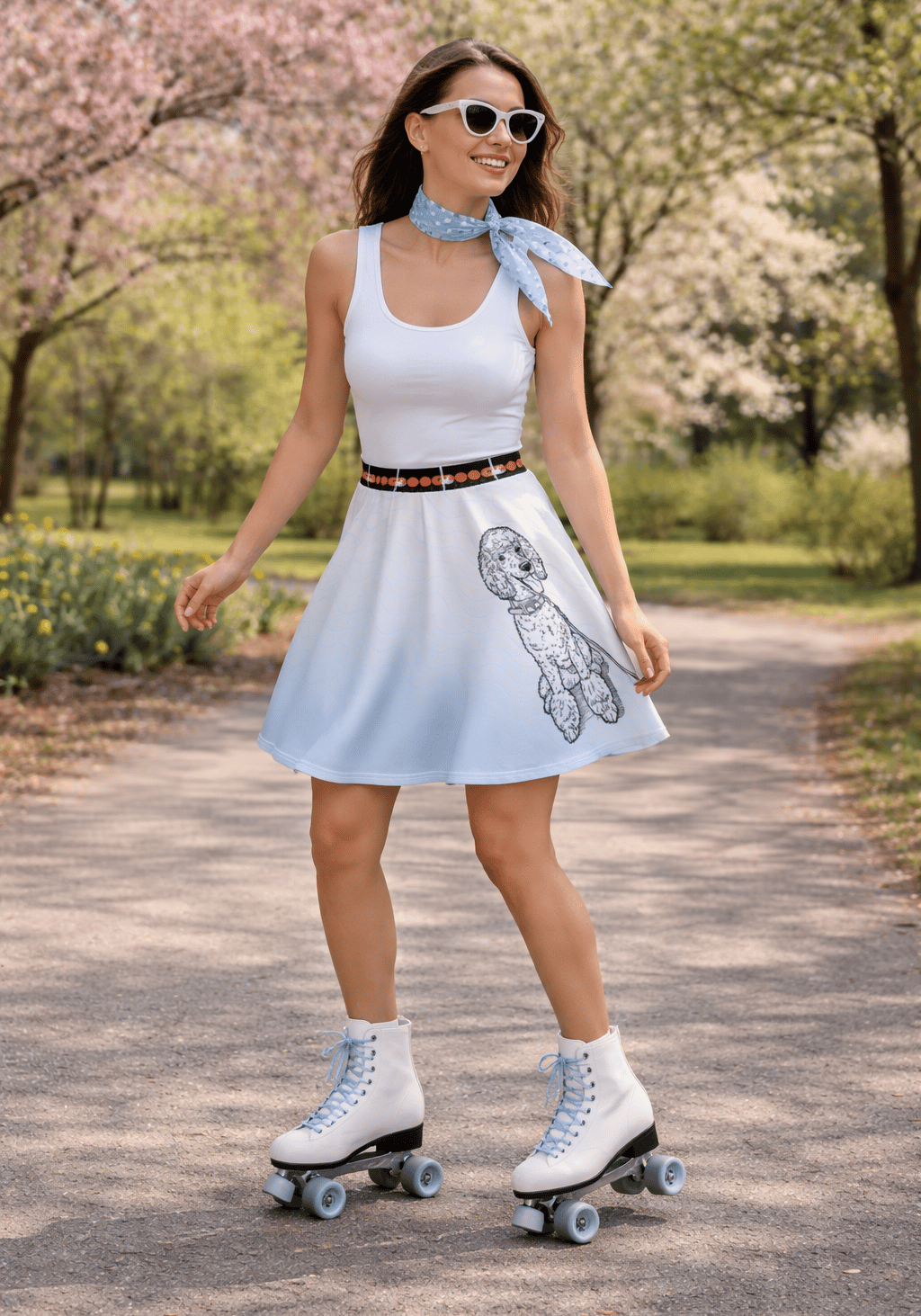
This version starts with Arturo.
Not as a symbol—but as a character.
Hand-drawn, clean-lined, and placed with intention, he becomes the focal point without overwhelming the piece. There’s personality in the illustration, but restraint in how it’s used.
It doesn’t try to recreate the past.
It builds on it.
A SOFTER APPROACH TO NOSTALGIA
The original poodle skirt was bold by design.
High contrast. Immediate. Graphic.
Here, everything shifts.
The palette softens into a light blue—something more fluid, more wearable. The line work feels lighter. The repetition at the waist adds rhythm without turning it into costume.
It nods to nostalgia.
But it lives in the present.
BUILT FOR MOVEMENT
The silhouette matters.
A slight flare. A natural flow. Fabric that responds as you move—not stiff, not structured.
It’s the difference between something you wear once…
…and something you reach for again.
Walking through a park, catching light between trees, the piece changes with motion. It doesn’t hold still—and it’s not supposed to.
THE DETAIL THAT MAKES IT YOURS
Look closer at the waistband.
A quiet repetition of smaller forms—subtle, almost like a signature.
It ties the piece together without pulling attention away from Arturo himself.
Everything has a place.
Nothing feels added.
WHY IT WORKS
Because it respects the original—but doesn’t rely on it.
It keeps the idea, removes the weight, and lets the design breathe.
That’s where it becomes wearable.
FINAL THOUGHT
The best reinterpretations don’t try to bring something back.
They move it forward.
Explore more from the Women’s Edit